Columbia, Panama, Mexico, Oh My! Recipe for TCK Tamales

These tamales are a culmination of my own personal tastes, a month of research, as well as this recipe for vegetarian tamales and this recipe for Columbian tamales. While they are time consuming to create, you’ll be rewarded with a delicious and long-lasting delicacy for the whole family to enjoy.

You Will Need:

  • Corn husks or banana leaves (corn husks are more common in Mexican tamales, while much of the Caribbean and South America uses banana leaves)
  • Cooking string (Not the UV proof thread you can see above!)
  • A steamer

For the masa:

  • 2 cups corn flour (maseca/ harina maseca)
  • 1 cup flavour broth (more on this below)
  • 1tbsp garlic salt
  • Warm water (not boiling, lightly steaming at most)
  • Oil/lard substitute- melted coconut oil, butter or vegetable oil

For the filling:

  • Fake meat (for my tamales I used Viv Era shawarma kebab & vegetarian chicken)
  • 2 carrots
  • 1 large white onion
  • 1/2 cup frozen peas
  • 1 potato
  • 1 seedless chili pepper (optional, for additional heat)

For the flavour broth:

1/5 or 1 cup liquid oil (melted coconut oil, butter or vegetable oil will do)

  • 1 tsp Cumin
  • 1 tsp Garlic salt
  • 1/2 tsp Onion powder
  • 1/2 tsp Paprika
  • 1 pinch Cayenne Pepper
  • 1/2 tsp Coriander
  • 1/4 tsp Aji Amarillo (or a pinch of tumeric for colour)
  • 1 tsp tomato puree
  • 1 vegetable stock cube
  • 1 red bell pepper
  • 2 spring onions
  • 4-6 cloves garlic

How to Prepare the Tamales:
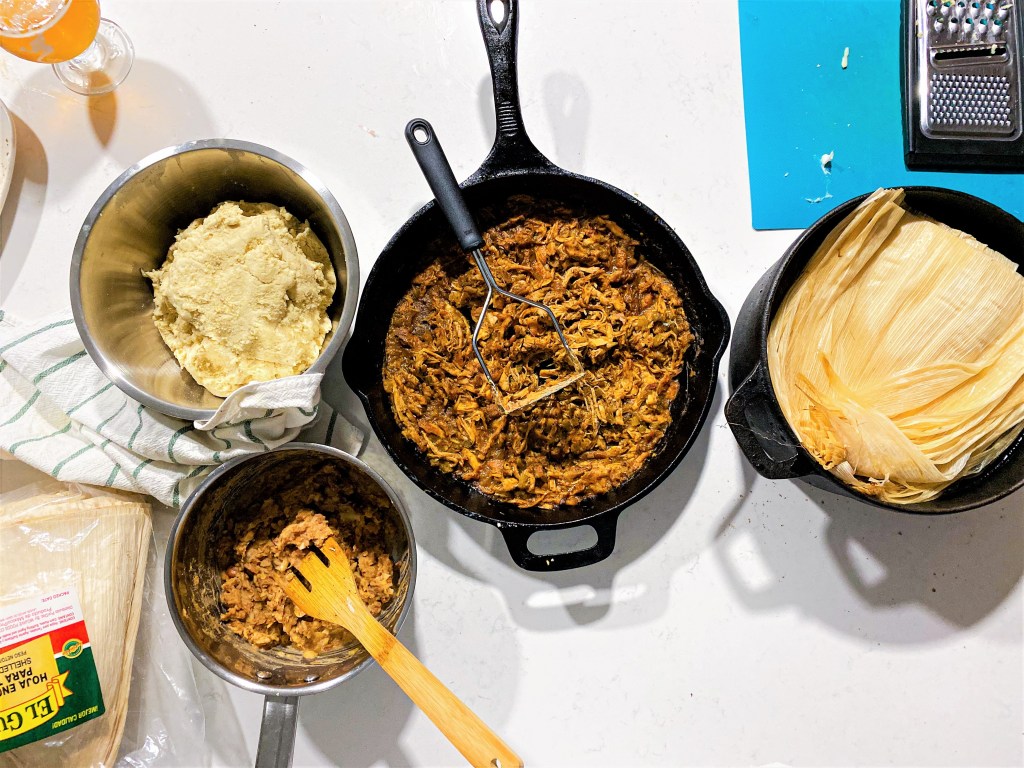
Tamale ingredients like masa, corn husks, pork, and red beans laid out on a table, ready to be assembled.
Tamale Ingredients Laid Out Together- Looks Aesthetic, Right?
  1. Before you start, soak your corn husks in warm water for at least 30 minutes. If you’re using banana leaves, pass them over a low heat to soften and prevent them from breaking. Put to one side.
  2. Let’s start the filling: use a low heat and large frying pan, letting a small amount of oil heat up. Finely mince the onion and cook until translucent, then add the carrot and potato. While this is cooking, you can make a start on the flavour broth.
  3. Place a small saucepan over a low heat and add the oil. Don’t worry if it looks like a lot (this is for adding flavour and texture to your masa later)- add your spices (the cumin, garlic salt, onion powder, paprika, cayenne pepper, coriander, and aji amarillo) as well as a stock cube. Mix for a minute while the oil heats up, but don’t let it boil or else you may burn your spices!
  4. Finely mince your spring onion and garlic. Chop your bell pepper before adding all of these (as well as the tomato puree) to the oil to cook until the bell pepper is soft. The oil should change colour to become red.
  5. Drain the oil into a cup (you should have at least one half of a cup- if not, add more oil and mix to distribute the flavour throughout), removing the bell pepper, garlic, and spring onion and adding these to the frying pan with your other vegetables. At the same time, add your peas.
  6. If your filling is cooked (the carrots and potatoes should be soft, but keep in mind they will be steamed inside your tamales as well so don’t have to be fully cooked) then remove it from the heat and put to one side. Time for the hard part- the masa!
  7. To make the masa (corn flour dough), use a large mixing bowl. Add the corn flour and the reserved oil. Mix it gradually, and then gradually add warm water until the masa is joined together, but is easily malleable. Add your garlic salt and mix for five minutes. Masa is traditionally mixed by hand, but if the dough is too warm you can use a whisk, electric mixer, or other equipment to save your skin!
  8. Add oil until the masa is gleaming, but not so much that there is a ton of oil in the bowl that refuses to combine- this means you’ve gone to far and need to add a bit more cornflour to compensate (a slippery hill into making the mix too dry again!) Youtube is your friend for knowing if the masa looks correct or not. Here are some of the reference videos I used:
    1. How to make masa for tamales with Maseca– CookingWithGloria
    2. Vegan and Vegetarian Tamales | No Lard and From Scratch– Cooking With Rusbe
    3. Colombian Tamales Recipe 4 | How To Make Tamales Bogotanos– Sweet y Salado
  9. Finely chop your fake meat, whether it’s vegetarian chicken cubes or shawarma pieces, you want to make sure it will be evenly spread and not overly chunky.
  10. Now for the fun (and tricky) part: assembly! Refer to the above videos for exactly how to do this, but here’s the run-down: take a corn husk, and use a large spoon to spread the masa around the inside, patting down any patchy parts with more masa. This should be a fairly thin spread, as the masa will grow when it’s steamed.
  11. Then, take a spoonful of filling and place it in the centre. Take a small spoonful of fake meat and sprinkle over the top before folding.
  12. To fold the tamal, first fold in the bottom (this is the part of the corn husk which isn’t pointy) and then fold in the edges so that both sides of the masa are touching. Roll it tight and secure with cooking string. If this step is particularly tricky, you’re probably overfilling your tamal.
  13. Once your tamales are all assembled, place them in a steamer for 45 minutes to 1 hour. You can tell that they’re done if you unwrap the tamale and everything stays in place- no masa sticking to the corn husk!

To Store a Tamale:

Many people make them in bulk and then freeze their tamales. If you’re going the freezing route, make sure you do this before cooking them, otherwise the tamale might get a little dry and crumbly once thawed.

To reheat your tamales, most people go the simple route with a few minutes in the microwave. Others re-steam them for 15-20 minutes (which might also prevent them from drying out as they reheat.)

What You Should Know Before Making Tamales:
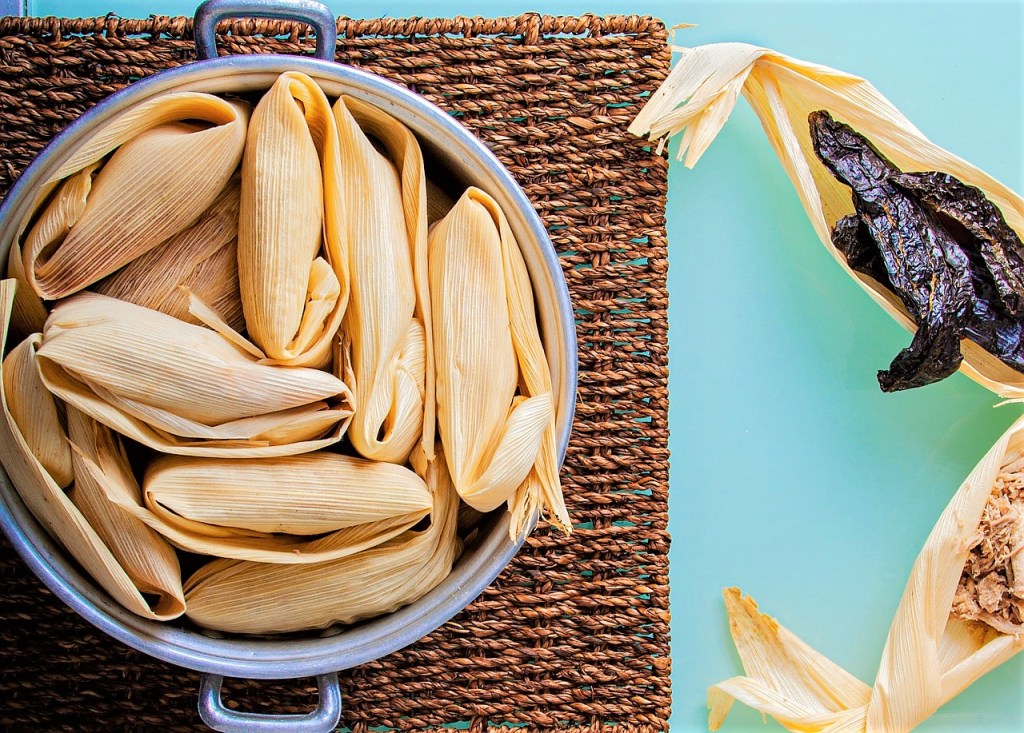
Tamales tucked together ready to be steamed in a blue bowl. Beside them are corn husks full of dried chilis & pork.
These stock photo tamales might look better than mine, but do they taste as good?

Tamales are a culturally significant food, with origins far older than the Spanish conquest of Latin America. They’re thought to be the world’s oldest portable food, and are easy to store and carry for long periods. Warriors carried them on hunting trips and during long journeys, women prepared them for ritual and celebratory purposes.

There is a Mesoamerican story that says the first humans came from corn husks. Indeed, throughout much of the Americas, corn was seen as a precious, life-giving substance with massive significance. Some sources even say that tamales were sacrificed instead of people after the Spanish invaders outlawed human sacrifices. As such, I like to remember that what I am eating is sacred and something to be respected, not mindlessly shovelled into my mouth while I eye up dessert.

In modern times, tamales are still closely linked to important events: they’re eaten at Christmas, at weddings and birthdays, and other special events… and they’re also a popular street food, eaten every day!

However, for many, tamales are particularly associated with Christmas. The holiday season in Mexico lasts from the Feast of Our Lady of Guadalupe on December 12th to Three Kings Day on January 6th.

Thanks to the long-reaching history and incredible variety of tamales, there is little limit to what you can put in them- some recipes call for rice and beans, while some breakfast tamales include bacon and sausages. There are even sweet tamale recipes made with fruit and sugar! For a more traditional approach, use chicken and pork, as well as vegetables like carrots and peas.

Before making tamales, make sure you do your research on how they are made- both to get the technical parts of cooking right, and to do justice to the incredible cultures they come from.

Why are these TCK Tamales?

A TCK, or ‘Third Culture Kid’ is someone who grew up in more than one country and who has absorbed culture from all of the places they have lived. I was born in the UK, but grew up travelling around South America and the Caribbean, making me a TCK.

My first Christmas in Columbia, I was getting used to the unfamiliar: my family didn’t speak any Spanish, and most of the things in the supermarkets were unfamiliar. We ate a lot of Doritos, because they were the only food we could recognise!

It was at a community Christmas potluck where I first tasted tamales. Tables were piled high with leafy green packages. I had NO idea what they were, but there were some very friendly locals placing banana-wrapped food on everyone’s plate, and growing up among different cultures taught me to never say ‘no’, especially when it came to food. So, I watched to see how everyone ate their tamales, and did what they did. I unwrapped the banana leaf, exposing bright yellow masa, and dug in with my fork.

From the first bite, I was hooked. A perfect mix of spices, meats, and vegetables. I had no idea what it was made from, but the whole dish felt like the gift it was.

Not speaking Spanish, I couldn’t ask what I was eating, what was in it, or anything else! For years I craved another mysterious package on my plate at Christmas, and had no words to ask for it.

Then, in 2017, Pixar released Coco. And there was this scene:
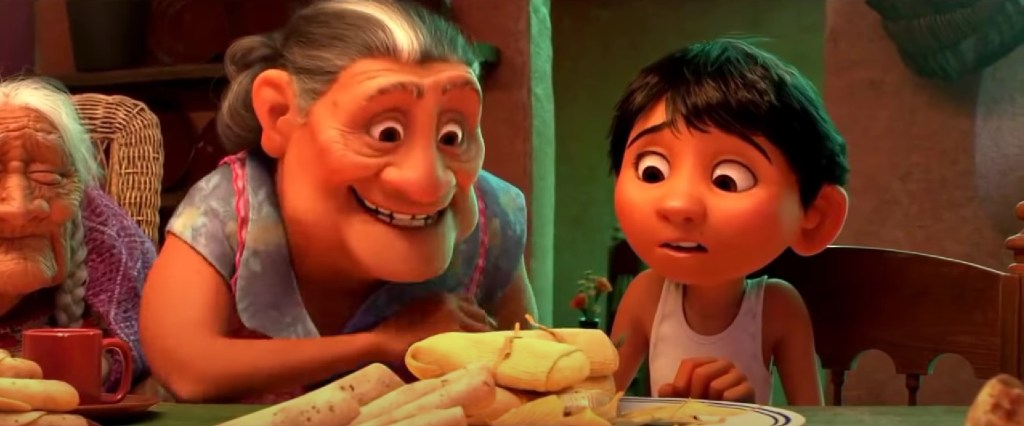
Screenshot from Pixar's Coco with Miguel and Abuela looking at a plate of tamales. She looks excited and he looks nervous.
Abuela from Coco force-feeding Miguel Tamales

Abuela: Aw, you’re a twig, mijo. Have some more.

Miguel: No, gracias.

Abuela: I asked if you would like more tamales.

Miguel: S-si?

Abuela: That’s what I thought you said!

Tamales? I thought. What are those? A quick Google later, and I knew that they were what I’d had all those years ago. But things were different: I was a girl caught in-between cultures (it was easy to look up ‘tamales’, but ‘TCK’ took a lot longer to understand.)

Now I lived in the UK, didn’t travel, and missed the other side of the Atlantic like there was no tomorrow. Not only that, but there was no way I could afford the ingredients for tamales, some of which are hard to find and expensive to ship. I no longer ate meat, adding another layer of complication to the situation.

This October, I moved to London. Outside the tube station at Elephant and Castle, you can find Latin food stores full of the right ingredients. All of them taste like home, even if I still don’t know what most of them are.

So, when our first Christmas in London came around, I adapted several recipes into this: my vegetarian, Columbian-inspired, TCK tamales. Why are these ‘Third Culture’ Tamales?

  1. A TCK made this particular recipe!
  2. Tamales are shared by cultures all around Central and South America. Much like a TCK, they are different in every country you find them: some are wrapped in banana leaves, some in corn husks. Some are stuffed with pineapple and sugar, while others are full of pork and chicken. All are delicious.
  3. Before making my own, I researched Tamale recipes from all around Latin America, from Mexico to Columbia, in order to create this recipe. In a lot of ways, it felt like re-tracing my own steps as I grew up: starting with the more well-known Mexican variety, moving into familiar Columbian flavours before researching Panamanian traditions and combining them into something delicious. This cultural mix suits my own nostalgia, as well as the palates of friends and family this holiday season.

Merry Christmas everyone!
What Does the Red Hand Mean for MMIW?

Summary

Indigenous women are extremely likely to go missing or be murdered. Statistics have been telling us this since the 1970s- although most of these are thought to be gross understatements, since many crimes against Native women go unreported or uninvestigated. 

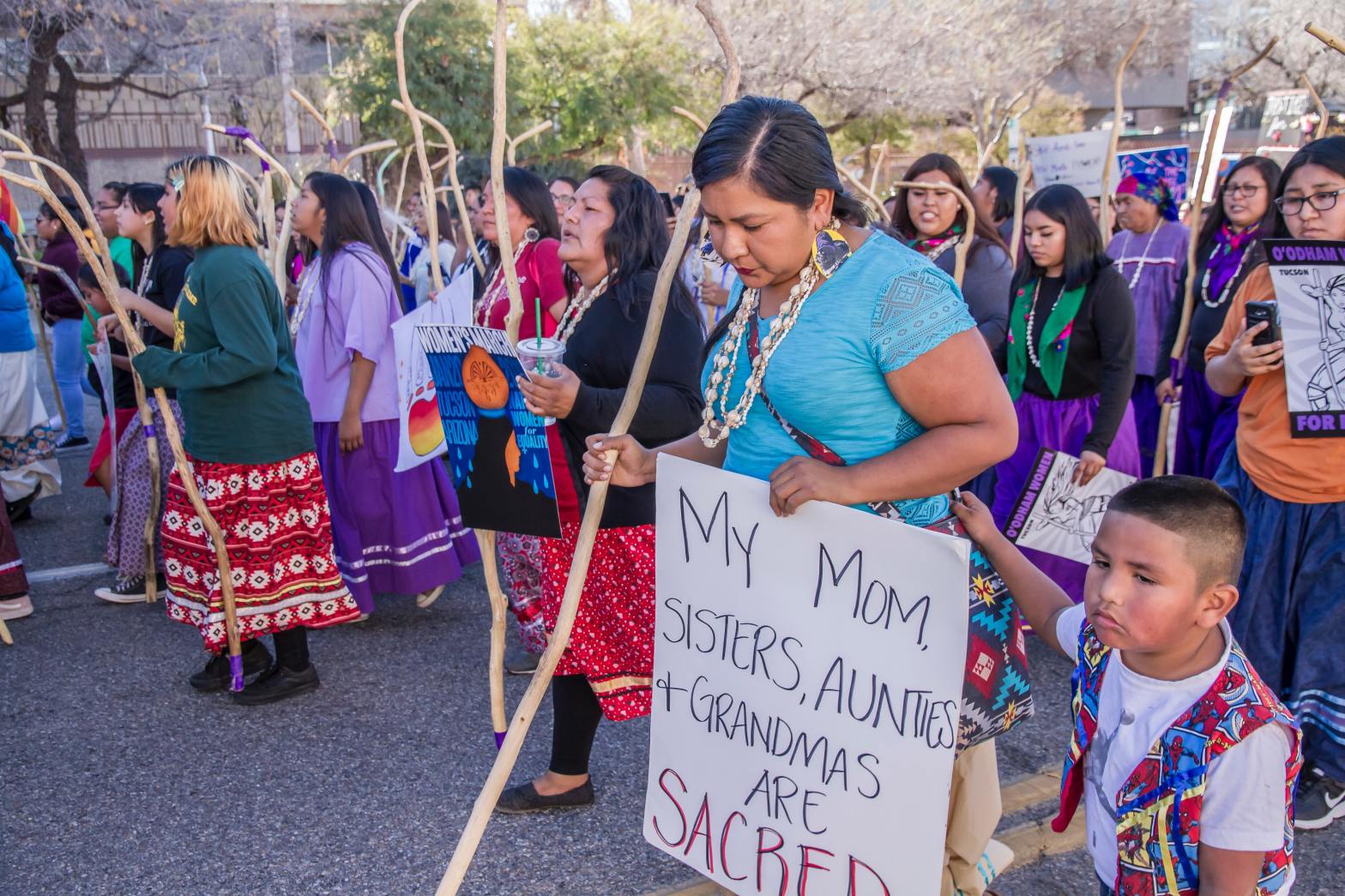
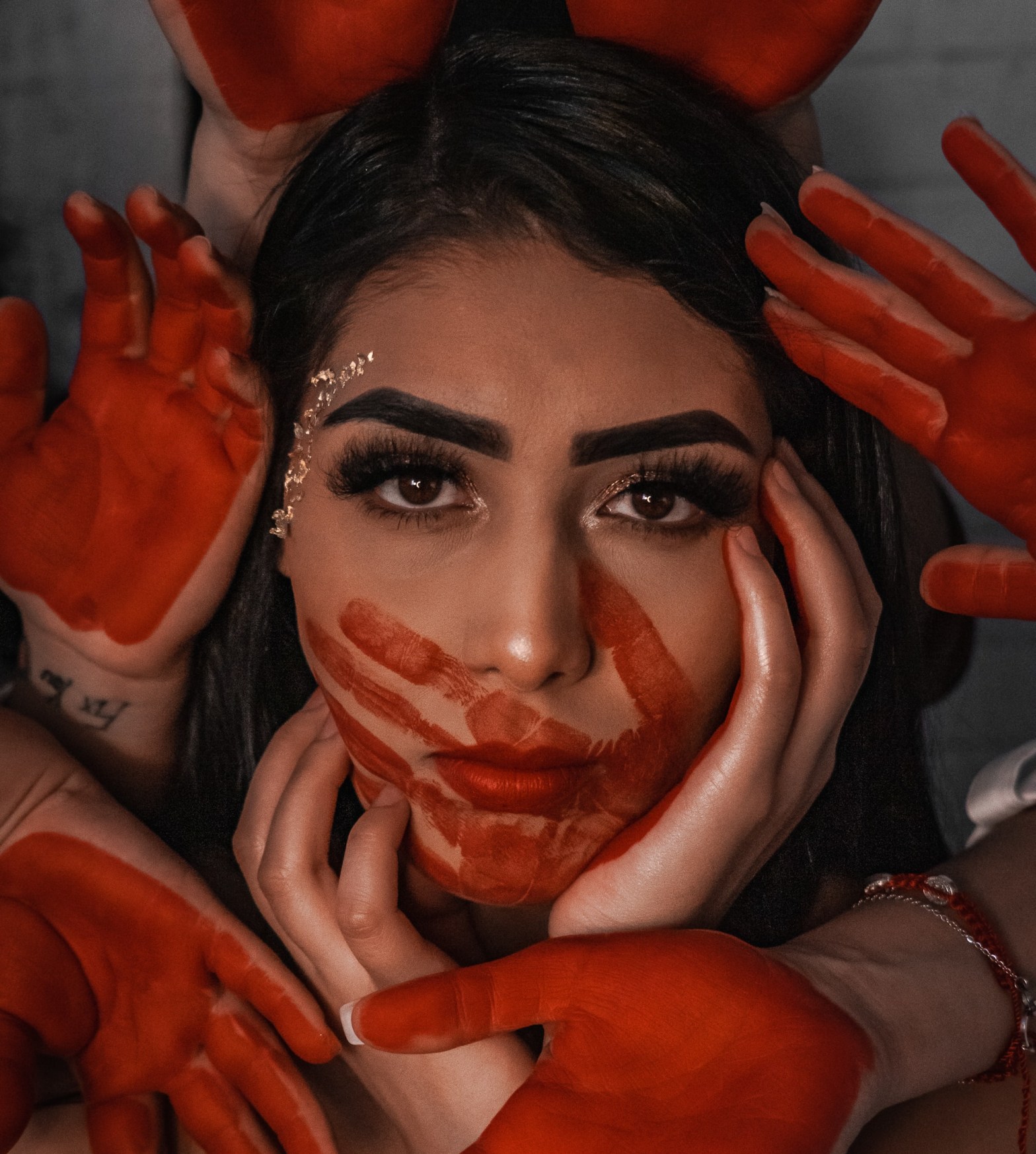
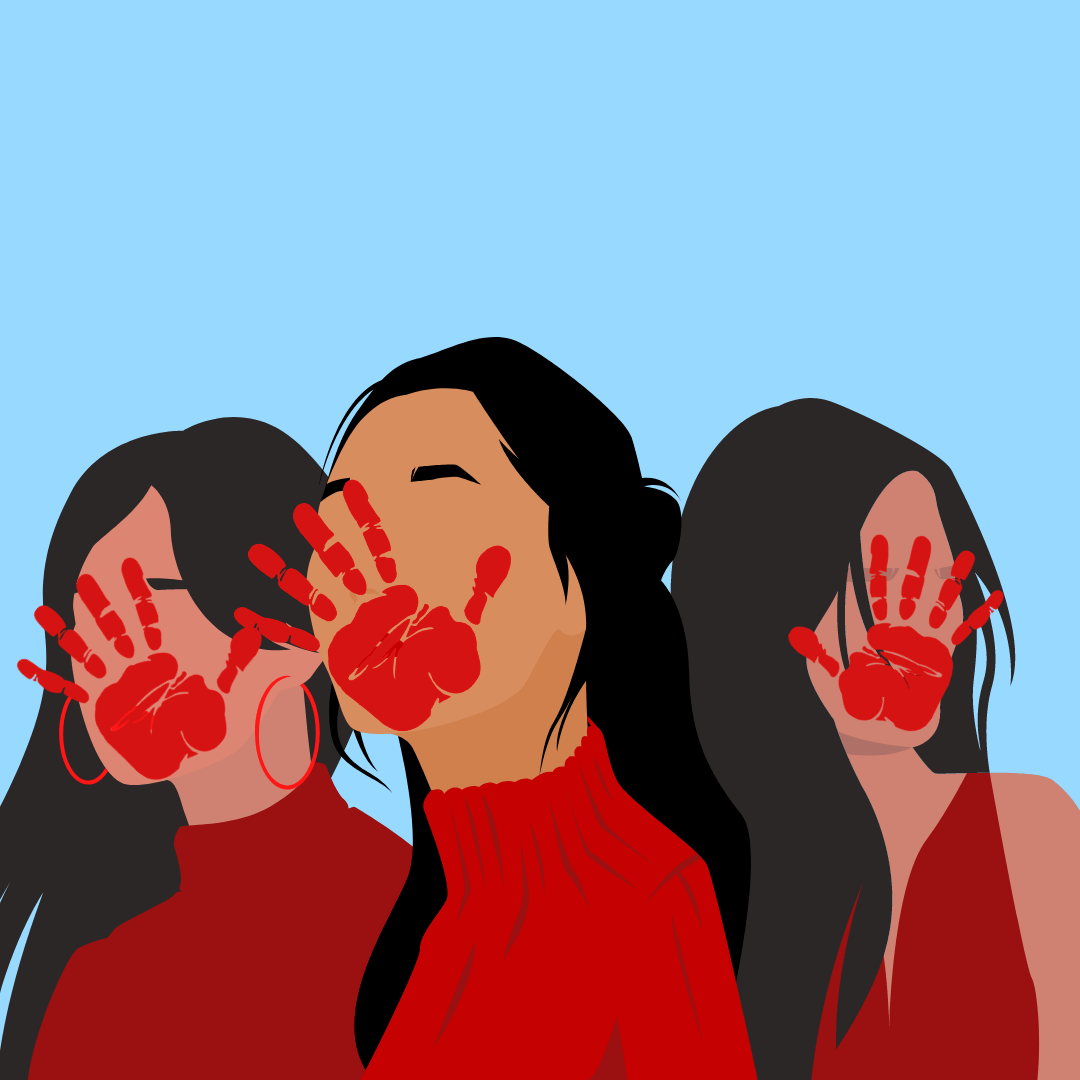
In recent years, awareness and calls for justice have been slowly growing, with many on social media and at organised events choosing to wear red handprints across their mouths, with matching red dresses, all as a way of showing solidarity and spreading awareness of the MMIW epidemic.

What is MMIW?

MMIW, standing for Missing and Murdered Indigenous Women, is a movement pushing for awareness and change for the staggering amount of Native women who have been ‘stolen’ from their families and communities by violence.

In some areas of the United states, Indigenous women are murdered at a rate 10 times higher than other ethnicities, with the majority of crimes committed on Native-owned land by non-Natives.

According to the CDC, murder is the third leading cause of death among Native women (as opposed to accidents and respiratory diseases, which tie for third place in the general population depending on how recent your statistics are). There are a lot of reasons why Native women are so over-represented in violent statistics– lack of attention from the media, legal and jurisdictional issues, lack of communication between local, tribal and state law enforcement, and more.

On social media, the movement is represented through hashtags like #mmiw, #mmiwg, #mmiwg2s, and others, such as #nomorestolensisters and #whywewearred. With a quick search, you can find videos and images of girls and women with red handprints emblazoned over their mouths, or wearing red dresses at official events.

The Red Handprint for MMIW

When talking about Native American culture, it’s important to recognise the diversity there. There are over 500 different tribes across the continent, after all. So, it should come as no surprise that there is a whole host of different meanings for the same symbols- the red handprint has different meanings across different tribes, but today its most widely-accepted meaning is all about MMIW.

Here are just a few connotations the hand print symbol on its own could have:

  • Success in hand to hand combat
  • Human life (with the symbol believed to channel energy to the wearer)
  • Spiritual power, strength, protection, and domination

Different natural dyes could be used to paint faces, horses, and more. Red dyes and paints were made from clay containing iron oxide, berries, roots, beets, and more. It symbolised violence, strength, blood, energy, power, and success in war. When used in face paint, it could also symbolise happiness and beauty. 

Red is also said to be a colour that the ancestors can see. In various ceremonies and pow-wows, some tribes dressed their children in red so that they could be introduced to (and protected by) their ancestors.

Nowadays, the red handprint is used to indicate solidarity with the MMIW movement, raising awareness for the epidemic of Missing and Murdered Indigenous Women across the United States and Canada. Often painted across the mouth, the red handprint symbolises the lack of voice given to Native women, and can be seen as a form of healing by expressing trauma.

Cultural Backlash?

Millions of posts, videos, tiktoks, you name it- are all over social media, claiming solidarity with MMIW. There’s usually some statistics, a woman’s hand over her mouth and brought away to reveal the handprint painted over her face. This has brought up some controversies among the Native community, with some saying the emblem can be used to mock or mislead people when it comes to MMIW.

The issue of Missing and Murdered Indigenous Women is so unspoken that in most conversations the only reply you get from mentioning it is a blank stare. So, spreading accurate information, taking the problem seriously, and not shying away from the enormity of the issue is vital.

Runner and activist Jordan Marie Brings Three White Horses Daniel described the increased use of the handprint as a ‘double-edged sword’- on one hand, it shows solidarity, unity, and support for the movement. On the other hand, for some Native people, the symbol can have a different meaning or context, completely separate from the MMIW movement. Others will pose for selfies in the ‘war paint’, or bring the symbolism into environments where alcohol or drugs are present, which can often come off as exploitative.

For Michelle Buckley, the red handprint represents silence and domestic abuse. In her eyes, the red handprint isn’t just for family members and survivors. She told the CBC in 2020 that, if people know why they’re using the handprint (to represent violence against girls and women), and they’re being genuine, then ‘that’s OK.’

Wearing Red Dresses for MMIW

The Red Dress Project (created by Jaime Black) started as a public art instalment in 2010. The Métis artist worked by hanging up red dresses in various locations to raise awareness for the Missing and Murdered. More than 400 dresses have been donated to the cause, with many victims’ families attending exhibitions. 

According to Black, since some believe red is the only colour spirits can see, the dresses are a symbolic way to ‘call back’ the spirits of these women and girls, to allow them to be among us once again while having their voices heard through their family members and community. Within the art itself, red also symbolises violence, vitality, our lifeblood, and the ‘connection between all of us.’

There is something haunting about the red dresses hanging from trees, windows, ceiling rafters, and just about anywhere else you could think of. The sliver of red fabric billowing in the breeze has a way of reminding you that there is no longer a woman there to fill it, and yet there is a certain ‘presence in the absence,’ too. While the dresses hang there, the spirits of these women are watching, waiting for justice.

National Day of Awareness for MMIW

While October 4 was the original day to hold vigils for MMIW, May 5 has recently been made the official day to raise awareness across Canada (there’s no law against it in the US, either). On this day, vigils and marches are often organised, red dresses are displayed in home and shop windows, and you can wear a bright shade of crimson for reasons more than a love of fashion.

Running for MMIW

There are a lot of ways to be an activist, and to raise awareness for different issues. When it comes to MMIW, many Indigneous women choose to run, or play other sports, while sporting some red paint of their own in order to start conversations on and off the track.

Jordan Marie Brings Three White Horses Daniel

In April 2019, Daniel dedicated each mile of the Boston Marathon to a murdered Indigenous woman or girl. She ran the whole thing with a red handprint over her mouth, and MMIW written on her legs. 

A citizen of the Kul Wicasa Oyate tribe from South Dakota, Daniel works at UCLA as an outreach and project manager, as well as being a documentary film producer, and even a sponsored runner for Lululemon’s global ambassador program. When asked why she used the red paint on her run, she said that she ‘wanted to do something’ with her run, to ‘give back to our stolen relatives and to their families.’

Rosalie Fish

In June 2018, Fish honoured several Indigenous women at her state track and field meet:

  • Misty Anne Upham (in her 400-metre final)
  • Alice Looney (in the 1,600m)
  • Jacquline Salyers (in the 800m)
  • Renee Davis and her unborn child (in the 3,200m)

All women were victims of violence, and were depicted on a poster Fish brought with her to the meet. It was the first time Fish (a member of the Cowlitz tribe in Washington) had ran for anyone other than herself, and ‘the first time I’ve ever made a scene and not been apologetic.’

She went on to say, ‘Nobody is going to listen to me. As a teenage girl, nobody has to care what I say. But when I run about it, people will notice.

The Ignacio High School Girls Basketball Team

In December 2019, every member of the Ignacio High School girls basketball team donned a red or black handprint and participated in a photoshoot to honour Missing and Murdered Indigenous women. 80% of players on the team come from the Southern Ute tribe.

Fans were encouraged to wear red to their game, and as part of the pre-game festivities there was an opening prayer, drum circle, and speech by Christine Sage, Southern Ute Tribal Chairwoman.

Final Thoughts

While the pandemic has us all inside, many unable to go to marches or protests for fear of infection, wearing a red dress, handprint, or other symbol of the movement can be considered one of few ways to show our solidarity with MMIW from behind a screen. There are more practical things you can do, too:

  • If you’re in the United States of Canada, you can write to your local representative and demand they address MMIW.
  • Share articles, information, posts, etc. 
  • Have conversations with friends and family members- make sure that after 10 minutes with you, they know what MMIW is.
  • Donate to different MMIW charities.

Simply Complicated: How Many MMIW are There?

All across the North American continent, Indigenous women, girls, and two-spirits are going missing or being murdered at crazy rates- in some places, they are victimised more than any other ethnic group. In this article, we’ll be discussing in detail just how many Missing and Murdered Indigenous Women (MMIW) there are in the US and Canada, as well as a few reasons this might be, including:

  • The Media
  • Jurisdictional Issues
  • ‘Man camps’ 
  • Lack of resources

And more. The issue is as complicated as it is important, so buckle up.

What does MMIW mean?

First things first: what is MMIW awareness? What does it mean? It feels like every day we wake up to another acronym to be aware of, but this one is so sinister it is instantly easy to remember: Missing and Murdered Indigenous Women. The movement is also known by the alternate hashtags you’ll probably see popping up now and again on social media: #mmiwg (g standing for girls) and #mmiwg2s (2s standing for two-spirits).

The plight of Native women and girls has been called a genocide by the Canadian government and an epidemic by even former president Trump’s government. With an official ‘MMIW day’ set as May 5th (as of 2017), the issue is increasingly prevalent in most Indigenous communities, however it is yet to enter worldwide discussions in the same way as Black Lives Matter. There are a few reasons for this, such as lack of media attention and the physical isolation of many Indigenous communities.

How Many MMIW are there?

How Many MMIW are There in Canada?

According to one 2020 article by the Guardian, Canadian Indigenous women and girls are twelve times more likely to be murdered or go missing than any other group. In June 2019, president Justin Trudeau’s government named the crisis a genocide, reeling from the final report delivered by a national enquiry that was years in the making. 

An action plan was due in June 2020, but (thanks to the COVID-19 pandemic) it was postponed- and that’s pretty much the last we’ve heard about it since, despite these shocking MMIW stats for Canada:

  • Over 4,000 Native women and girls have gone missing in the last 30 years. That’s 133 a year- three a week. 
  • Most MMIW cases are murders, not missing persons.
  • According to the NWAC, between 2000 and 2008, Native women and girls made up 10% of all female homicides in Canada, despite being just 3% of the population.
  • Only 2% of the cases in the NWAC’s database occurred before 1970, suggesting there are many older cases that have gone undocumented.
  • Only 8% of MMIW cases  involve women over 45, and 17% involve girls under 18 years old.
  • Almost half of murder cases in the NWAC database remain unsolved.
  • Only 53% of murder cases lead to actual murder charges, as opposed to the 84% overall homicide clearance rate for Canada.

Finally, a more recent number: Native Women make up 4% of Canada’s female population, but made up 16% of female murder victims from 1980-2012, according to a 2014 report by the Royal Canadian Mounted Police (RCMP).

Even after the national enquiry into MMIW began, and the government start taking an active interest in the issue, there was no sense of deterrence reflected in the statistics. One 2019 CBC article reported that there have been three deaths of Native women and girls every month from 2016-2019. Most of these deaths were one of three types:

  • Homicide
  • Unknown causes (but suspicious circumstances)
  • Death while in institutional care or custody

How Many MMIW are There in the US?

As of 2019, multiple Western states (as well as Congress) have started creating legislation and enacting executive orders centred around the MMIW epidemic. Though no studies comparable to those in Canada have taken place yet, meaning there is simply no way to know for sure the true MMIW stats in the United States, but here’s what we know from what has been conducted:

  • 84% of Native American women have experienced violence in their lifetime, according to a 2016 study by the Department of Justice.
  • On some reservations, Indigenous women are murdered at 10x the national average.
  • 96% of the violence is perpetrated by non-Native men. 
  • 67% of cases involving Native-related sexual violence were declined prosecution by US attorneys.
  • On some reservations, 96% of women experience sexual violence.

One study by the Urban Indian Health Institute (UIHI) compared information gathered across the country to information from law enforcement agencies and comparable groups. The numbers indicated there were 5,712 missing or murdered Indigenous women across the United States in 2016 alone. However, only 116 of these cases were recorded in the US Department of Justice’s ‘official’ missing persons’ lists.

Current numbers from the UIHI and National Crime Centers show over 5,000 Native women go/have gone missing every year since 2016, but some numbers put this much, much higher. 

In November 2020, then-president Trump signed an executive order to create an MMIW task force.

It’s also worth mentioning that MMIW stats across the US and Canada are likely to be much higher than we think, since Indigenous women are often mistaken for Latina, Caucasian, or Asian women; and are therefore racially misclassified when they are found, or when ‘official’ missing persons information comes out.

Why is MMIW Happening?

If you want a famous example of a MMIW, look at Pocahontas, a native child who was sex trafficked and taken to England, where she was likely pressured into marriage with one of her captors. She wasn’t the first, and she’s far from the last. I mention her here just to give you an idea as to how long these ideas have been festering, mostly unchallenged, throughout history. 

It’s important to realise that MMIW isn’t because of any one issue- there are many, many things you have to look at and understand before we can talk about possible solutions. That being said, here are a few possible causes of MMIW:

  • Native women have been fetishised and exoticised by colonial authorities– if the patriarchy/male gaze has dehumanised women as a whole, it has dehumanised women of colour (including Native women) tenfold.
  • Jurisdictional Issues– the majority of crimes against Native women are committed by non-Native people, which is a bigger problem than you might think. Tribal authorities have little jurisdiction over sexual crimes or murders committed by non-Natives, even if the crime happens on Native territory. Essentially, non-Natives (particularly speaking, white men) are not held to account for their sexual or other violent actions towards Indigenous women and girls; by law, they can’t be punished or properly investigated by tribal authorities.

The federal government is supposed to pick up the slack here: they are tasked with investigating these violent crimes and punishing the culprits, but, as we stated earlier, they decline to prosecute almost 70% of cases.

  • ‘Man camps’ – By now, you’ve heard about pipelines and protests about Native land. What you probably don’t know, however, is the problem posed by the workers who make pipelines. Work-camp modular housing, also called ‘man camps’, are temporary housing communities made for the mostly male workers, and are often located close to Tribal lands or other marginalised communities. Despite numerous reports, studies, and congressional hearings connecting these camps with higher rates of sex trafficking and violence, little is being done to help police the issue. 

Worse: many rural communities don’t have that many police officers to begin with, and they can be left policing a sudden influx of hundreds of outsiders- and, if a non-Native commits a crime on Tribal lands, they often can’t be investigated by law.

  • Inadequate Police Response– Canada’s national enquiry into MMIW found a lot of problems around police responses to Native issues. Whether it’s individual or institutional racism, or a combination of the two, the result is the same: police failure. Lack of trust in law enforcement. Both issues span generations, and if no reparations or recognitions are done, the problem will continue.
  • Lack of Resources– there have been calls for Indigenous communities to have proper funding for their own police services, as well as proper jurisdiction. While these services already exist, look no further than the First Nations Policing Program in Canada, which has been described as ‘chronically underfunded’, leading to burned-out officers, more lack of trust in law enforcement, and as a result, an inability to properly investigate violence and sexual crimes in First Nations communities.
  • Human Trafficking- 2016 statistics from the RCMP showed that, while Native women were 4% of the Canadian population, they were 50% of human trafficking victims. Of those, almost 25% were younger than 18 years old. Murder is not an uncommon result of human trafficking, either. Common places recruiters will pick up women and girls can be: bus stations, airports, schools, hitchhiking, and essentially anywhere a woman might be alone or far from home.

Final Thoughts

There may well be light at the end of the tunnel for MMIW, but for now the issue is ongoing. With the Canadian government postponing any recommendations post-enquiry, and scepticism around Trump’s MMIW taskforce having adequate funding, change is a long way off. And we don’t have that long- people are dying. While the Canadian report made hundreds of suggestions, here are just a few things that could help stop MMIW:

  • Proper awareness
  • A national database for missing Native women
  • Proper jurisdiction given to Tribal authorities and governments
  • Support and resources for First Nations communities

This issue permeates all levels of society, and all nations have some kind of reckoning to be had with colonialism; not just North America. It’s not the job of any one agency or person to ‘fix’ the problems around colonialism or MMIW, but the least you can do is have a conversation, take action to raise awareness, and go from there.

Invisible Genocide: What is the MMIW Movement?

Summary

Despite the MMIW epidemic showing no signs of stopping, there is a criminal lack of information being spread by governing bodies across the United States and Canada, much less action being taken to protect First Nations Women. MMIW refers to ‘Missing and Murdered Indigenous Women’. In this article, we’ll be discussing topics such as, ‘how many MMIW are there?’ and taking a look into the basics of the movement, as well as what we can all do to help stop the crisis.

What is the MMIW Movement?

The MMIW Movement as we think of it today was created in 2005, when Bridget Trolley founded the Sisters in Spirit vigils, which continue to take place across Canada on October 4, in honour of the thousands of Missing and Murdered Indigenous Women who have gone missing since the start of colonisation. Those who have gone missing since 1980 are particularly remembered (since records before this time are essentially nonexistent). 

You might also see the hashtags #mmiw, #mmiwg, and #mmiwg2s (the g standing for girls, and 2s standing for two-spirits) floating around on social media from time to time. As with most internet trends, it’s hard to pin down who started this, but the cause is very real, and the reason behind it is clear: Native American women (and those who identify or present as women) are extremely likely to be sexually assaulted or experience violence compared to other demographics, and are less likely to have crimes against them reported, investigated, charged, or adequately recorded. 

Why is MMIW Happening?

There are a few reasons why the MMIW crisis has been called an ‘epidemic’ in the United States and a ‘genocide’ by the Canadian government. The problem began with the start of colonisation, when the first European settlers set out to ‘civilise’ the ‘New World’ (and enslave or murder all the perfectly civilised people already living there), but it has persisted until present day, over 500 years later.

There are no excuses, but a few reasons for MMIW:

  • The media won’t give Indigenous issues enough attention: one 2018 study by the Urban Indian Health Institute found that 95% of MMIW cases were not covered by national or international news media.
  • Foggy jurisdiction on reservations: often, it’s legally disputed whether tribal authorities, the police, or governmental bodies should investigate serious crimes, and tribal authorities often aren’t given the authority to properly punish crimes like murder or rape.
  • ‘Man camps’ created by the fossil fuel industry: these are typically located on or near Native lands, and are commonly connected to an increase in the sexual assault, murder, and trafficking of Indigenous women.
  • Lack of resources: there is no proper database for MMIW in the US or Canada, and a common excuse is that there is not enough funding for such a project, of such a scale. Couple this with the fact that Native women can be misclassified as Hispanic or Asian on everything from wanted posters to Jane Doe records, and you have a recipe for misinformation, disaster, and a seemingly invisible genocide that doesn’t properly show up on many databases or in statistical reports.

Why is MMIW important?

Injustice anywhere is a threat to justice everywhere- that’s what Martin Luther King Jr said, and who are we to argue? There is no point in pretending to be an advanced, modern society if we continue to support the colonial measures put in place by our racist forefathers. There is no acceptable reason why First Nations women, girls, and gender non-conformists should continue to go missing at such an awful rate, and frankly, the amount of people asking the question ‘why is MMIW important?’ shows how much work there is left before we can find ourselves in a truly comfortable and equal society.

How many MMIW are there?

As mentioned above, when Indigenous women go missing or are murdered, it often goes unrecorded or is not properly investigated. While the Royal Canadian Mounted Police (RCMP) maintain they treat Native peoples the same as any others who come to them with a missing family member, Indigenous organisations and families of victims have consistently complained that they are ignored, their loved ones’ plights often go uninvestigated for days or even weeks at a time- if they are ever properly looked into at all. 

To simplify the question, we’ll answer it in two parts:

How many MMIW are there in Canada?

While a 2014 report by the RCMP claimed the number was just over a thousand (looking at data dating from 1980 to present day), Native groups argued the number was closer to 4,000- and a 2018 governmental enquiry argued that the true numbers can likely never be known for sure, but, as of 2019, President Trudeau declared the crisis a genocide nonetheless. 

How many MMIW are there in the US?

In the United States, statistics for MMIW are even more worrying- because we don’t truly know them. A study by the Urban Indian Health Institute stated that murder was the third leading cause of death for Native women across America, and that there were roughly 5,712 cases of MMIWG reported in 2016- but only 116 of these were logged in the official Department of Justice Database. Not to mention the fact that research had been done on women living in urban areas, despite the fact that over 70% of Indigenous women in the United States live in urban areas.

What can I do for MMIW?

A popular answer to this question is ‘eat the rich’, but we don’t think they’d taste very nice, so here are some more productive alternatives:

MMIW Day

As of 2017, May 5th is the official day to remember and honour Missing and Murdered Indigenous Women. This is a day to challenge the silence of authorities on the issue, whether it’s local law enforcement or politicians. Most of all, however, it’s a day to have conversations and spread awareness as far as you can for the crisis. Do what the media won’t: bring attention where it’s needed. 

Here are some ideas of how to respectfully acknowledge MMIW Awareness Day:

  • Organise community runs, public art displays and performances, and conferences where people can be heard. 
  • Make good art: produce songs, videos, and writing to raise awareness of the cause. I’ll also be putting together an anthology of all types of writing that you can submit to until May 30th, 2021 (message me on Instagram or Twitter if you’re interested, or leave a comment and I’ll get in touch with you!)
  • Wear red, and make a point of telling people around you why you are wearing red. 
  • Post a picture of you in red (or other useful information) on social media using the hashtag #MMIW, #MMIWG, or #MMIWG2S.
  • Donate.

Donate to MMIW

While we will take a deeper dive into this in a later post, there are many good and reputable organisations you can donate to if you want to put your money where your mouth is when it comes to stopping the crisis of Missing and Murdered Indigenous Women across North America.

The National Indigenous Women’s Resource Center (NIWRC

Their mission is to end violence against Indigenous women, as well as give tribal authorities the power to hold perpetrators to account for their actions. Much of their work goes towards uplifting the voices of various grassroots advocates in tribal communities.

The NIWRC also provides technical assistance, educational resources, training, and have an active hand in policy development in support of tribes and advocates for Native rights.

The Native Women’s Association of Canada (NWAC)

The NWAC works throughout Canada to represent the political voice of girls, women, and gender diverse Native people, whether they are on or off reservation, hold a recognised ‘status’ or not. They also include Métis and Inuit people in their work. 

Their founding focus is to enhance and promote the economic, cultural, social, and political wellness of Indigenous women in Canada. Much of their work is aimed at legislative analysis and policy reforms to ensure equality for Native women, Two-Spirit, and LGBTQ+ people. The issues they work on are as diverse as the peoples they support: labour, business, employment, health, violence (both prevention and safety) justice, human rights, environmentalism, and international affairs.

Coalition to Stop Violence Against Native Women (CSVANW)

CSVANW is an advocacy group for Native women and children with a focus on breaking cycles of violence, which often span through generations of Indigenous families (though this is often not their fault, but the fault of residential schools breaking down family units over many years).

They advocate for better services, response, and community-led approaches to prevent sexual and domestic violence using strength-based community programming.

Conclusion

Now, it’s important to note that this is only the tip of the iceberg. When it comes to Missing and Murdered Indigenous Women, as well as Native rights in general, there’s a lot to unpack (500+ years of it, in fact). So, make sure this article isn’t the last you hear about the MMIW movement. Engage in conversations with those around you, spread the word, and do what you can to not only spread awareness, but incite real change for the better.

Race, from a TCK Perspective

You would look at me funny if I told you I’ve experienced racism. I’m pale, blue-eyed, and as a kid I was platinum blonde. I grew up privileged, travelling the world on a frickin’ yacht, so what could I possibly mean when I say,

‘I’ve experienced racism.’

Hmmmmm?

Well, by most definitions, I haven’t. I have never been in a place where my race caused people to view me as lesser, where it would stop me getting a job, where being pale was not seen as a marker of beauty due to some absurd standard of colourism. I know nothing of oppression and real hardship.

One definition of race goes by power dynamic, saying racism is ‘discrimination from a dominant racial class to a non-dominant one’. For the purposes of my statement, I am going with the definition as it is found on Dictionary.com, which reads in part:

Hatred or intolerance of another race or other races.

I grew up as most TCKs do, with a big group of friends from a dozen different cultures. Black friends, Asian friends, Bangladeshi friends, Hispanic and mixed race friends. I understood them and their cultures for what they are: beautiful, diverse, and necessary.

But then my family reached mainland South America, and from the moment we set foot in Columbia we knew all eyes were on us as representatives of our race. We were always the only white people in any situation, and people often muttered under their breath as we walked past in a language we as psuedo-immigrants could not speak.

In Panama, we were seen as tourists due to our skin colour. Being white meant a whole lot of assumptions: we must be rich, we must be American, we must be gullible and easy to take advantage of. It was an excuse for people to yell at us in the street and push some miscellaneous good or service at us, for cab prices to be hiked, etc. It was not violent, but there was always the feeling of some superficial discrimination in the air.

I was thirteen the first time a racial slur was used against me, with a slashing motion across the man’s throat as he looked at my family and I with disdain. In Peru, we were seen as colonisers, the enemy. The evil deeds of Conquistadors from hundreds of years ago, the erasure of entire cultures, was placed on my family in that moment. And I agreed with him- I hated Europeans and Americans on principle, unable to see that I was one of them but at the same time finding it impossible to remove myself from that evil image.

As a teenager, I wanted to look the same as everyone around me: shorter, curvier, darker, long black hair. I didn’t want all eyes to be on me and my family. I wanted to be a local.

I wasn’t educated about white priveledge until much later- I knew the history of colonisation and the pain my ancestors had caused, and I knew that when people hiked up their prices just or me and my family it wasn’t anything personal; it was just business. An assumption based on our race that we could afford fifty dollars for a blanket that would have been twenty for anyone else. I still don’t blame those people for the way we were treated, because that is how colonisers forced them to survive- I may not have been fully aware, but I was surfing a tidal wave of priveledge and expectation carefully cultivated by years of damage done to the’real’ locals.

I don’t even blame the man who acted so aggressively towards my family. Europeans have a history of being assholes, and in that man’s town history was continuing right before our eyes, with a rich Italian man showing up, calling himself an archeologist, excavating sites vital to that man’s culture, exporting sacred artifacts and actual ancestors back to Italy, never to be seen again by their descendants.

I know the ‘racism’ I experienced is based upon white priveledge and centuries of oppression- and it is not the racism we need to be focusing on today.

I’m privileged enough to be grateful for my experiences, in a way. I get to understand a fraction of the racism people of colour go through every single day, the physical insecurities brought on by Caucasian beauty standards, the pain of being told you ‘look like an immigrant’ even though you’ve never lived anywhere else… It really fucking sucks.

I’m not saying I’ve experienced racism to prove the existence of ‘reverse racism’- that is so far from being the problem it is not worth adding to the conversation. My point is, if I, an excessively privileged white girl, can feel even a fraction of that kind of discrimination, what must young children of colour feel every day when they see things like George Floyd? When their parents get pulled over for driving while Black, with them in the backseat?

Things like police brutality cannot continue happening with no accountability.

So, I decided to do something small to help those who actually need it.

I put out a call for submissions for an anthology ‘In Service of Black Lives’ over social media, and started bothering every writer I know. A lot of them were white and didn’t feel comfortable writing about racism. I understood that, but at the same time I fundamentally disagree: white people need to start owning up and recognising racism around them. Not just when it happens to them. I guarantee if you open your eyes you will find friends and strangers, the people sat beside you on the bus, who have been dealing with racism on small and large scales. To paraphrase John Leguizamo, ‘(people of colour) have to learn to stand up for ourselves, but we need a little help from the white liberals, too.’

In the anthology, I and others tell our full stories about race, life experiences, and also write fictional pieces and poetry based on current events and racism.

Proceeds from the anthology are going to two charities:

THE NATIONAL BAIL FUND NETWORK

This is a network of over sixty community bail funds across the United States. Their work is not localised to paying bail/bond, but also fighting to abolish the money bail system and pretrial detention, as well as immigration detention.

Their work is especially vital right now, as the COVID-19 Pandemic has turned many prisons and jails into hot spots for the virus. During the Pandemic, they are fighting to release those detained who can and should be freed under the current money bail system, as a way of flattening the curve and keeping people safer and healthier than they would be behind bars.

Much of how the United States legal system will treat you is tied not only to your race and social position, but also to your income. The National Bail Fund Network is a sort of pool of money between communities to help fight multiple drivers of criminalisation and incarceration from the bottom up, such as court fees, fines, probation/parole, etc…

KNOW YOUR RIGHTS CAMP

In addition to doing a TON of work helping Black and Brown communities throughout the pandemic, Know Your Rights Camp is an educational experience providing vital information to young minorities. The initiative began as a way to teach young people how to handle encounters with law enforcement, and expanded to giving young people the resources, access, and knowledge to brighten their futures.

These conversations are a vital education, and yet they aren’t the kinds of things you’ll find in schools: what do you do if you’re pulled over by a police officer? What are your rights? This free camp educates, empowers, and mobilises the next generation of Black and Brown leaders. If we want the world to change for the better, we need to be investing in things like this.

Additionally, their Legal Defense Initiative has connections with top defense lawyers and Civil Rights lawyers across the United States to provide much-needed legal resources to people and communities suffering from injustice and police brutality.

The only way racism goes away is if we confront it head on and say: ENOUGH. No more George Floyds and Breonna Taylors. Enough of institutional racism. We call ourselves a meritocracy? Let’s start acting like it.

The book is available here in the UK and here in the US, but you can buy it anywhere via amazon. Samples of the writing are up on my Instagram.

Lonely Third Culture Kids

David C. Pollock maintains that there are five types of traditional TCKs: Foreign Service Kids, Military Brats, Corporate Brats, Missionary Kids, and Other. I’m… not really sure how ‘Other’ is traditional, but it’s nice to be included.

One thing I love about my identity is how it can be shared with people who have entirely different lives to mine. Everyone knows by now I’m a TCK because I grew up on a boat, and they seem to (correctly) think it’s pretty cool. They discount their own reasons for being TCK by waving off questions and saying ‘my story is boring’ or ‘does it matter?’

But then you wear them down and you learn something crazy like ‘my dad was a diplomat’ or ‘my mom was a marine’ and there’s this huge family story about how and where they’ve lived, and it’s awesome! I just bobbed around in the ocean for a bit; Traditional TCKs were living lives surrounded by interesting people, going to international schools, learning about the world with their eyes wide open.

Pollock defines Traditional TCKs as:

‘A Traditional Third Culture Kid (TCK) is a person who spends a significant part of his or her first eighteen years of life accompanying parent(s) into a country or countries that are different from at least on parent’s passport country(ies) due to a parent’s choice of work or advanced training.’

Even after 21 years of being a TCK, it fascinates me that other people have been researching this since the 1950s or so. I love that I can meet other TCKs and already know them, even if we are strangers. It’s like meeting a family member for the first time, only there’s no awkward silence full of expectations like ‘why aren’t you married yet?’ There’s just acceptance and understanding. Norma McCaig calls it a ‘reunion of strangers’, which I think is the perfect turn of phrase.

Wanna know something else? In our increasingly globalised world, more and more people are growing up in multiple countries. There’s certainly more Foreign Service Kids and Corporate Brats in the world than ever before, and look at me! I’m something new, something other, something very untraditional, but I’m still a TCK. The way the world is growing, there are going to be more and more TCKs all around the world, and as more people even within single countries are influenced by outside cultures, there’s going to be an increased understanding of TCKs.

It’s easy to feel alone when you’re the only person living your life… especially when that life is as unique as a TCK’s experience. But just remember: you have a global family who gets exactly the same feeling you do, and we’re here for you.

Boat Kids and TCKs

Getting to know other Third Culture Kids, I’ve had a realisation: growing up on a boat makes the TCK experience pretty damn different. The ‘typical’ experience is to move every two or three years from place to place, school to school, and really only feel at home in an airport because you’ve travelled so much.

Yeah, the boat life makes that look downright stable.

Growing up, My family moved every few weeks. Our longest stay was in Panama for six months, and that was only to renew our passports. Then we crossed the canal and into the Pacific ocean, immediately going to the Galapagos islands, where the longest staying permit we could afford was three weeks or so.

Other TCKs are known for their empathy and charisma; coping strategies evolved from joining multiple schools in short spans of time and having to completely rebuild their social lives every time. As a boat kid? You have no social life. There are very few families on boats, and even when you do find the proverbial needle in a haystack that is another boat kid, you’re still going to be moving away in a week or so.

This makes boat kids extremely capable of becoming fast friends. When I was younger, I would immediately give my life story over to a new friend, along with all my opinions and interests and personality quirks, because there wasn’t time to disseminate this information slowly. Other boat kids were the same, and it was great.

…Until we moved onto land and into regular schools, where all of a sudden what had been ‘charisma’ on the boats turned to ‘freakishness’ in the eyes of other kids. We might as well have been a different species when it came to friendship and communication styles.

‘I remember when I was in Peru, there was this-‘

‘You’re so random!’ Said one of my fresh high school friends. ‘Everything you say is like, when I was in Peru, when I was in Ecuador, there’s nothing like, yeah, I went to the supermarket the other day.’

And she was right, and then I saw the looks on everyone else’s faces, and I knew. They thought I’d been bragging, like some posh girl who goes to Thailand on a gap year and comes back ‘enlightened’ with a 3 hour powerpoint of every sweaty hostel she stayed in. How were they to know that this was how boat kids talk? We share our experiences of places we’ve been, things that happen on the boats, travel and food, etc, in casual conversation. It’s not a big thing, or showing off; it’s just how life is.

Peru had been my life for a month, and I’d only been in the UK for two weeks at this point. I’d always labelled myself as a confident, funny, and charismatic person. But now I had no experiences relatable enough to be funny or charismatic. To these girls, the story of the time I nearly drowned in shark-infested Pacific waters was a harrowing and flashy tale; to me, it was a funny story. I’d never been to a British supermarket, or town centre. Hell, I’d never crossed a road on my own before I was fourteen years old. I didn’t know how to fundamentally function on land, nevermind in school.

Most TCKs are bilingual. On boats, you talk to boat people. Most boat people are European or American, so there’s always an abundance of English-speakers around you, even when you go out. When you’re moving around so much, what’s the point of learning the language where you are, anyway? It’ll be useless in a fortnight. I’m still embarrassed at how shocking my Spanish is, despite considering myself at least partly Suramericana. On a boat, you simply aren’t exposed to local culture in the same way you are if you live in a house and go to school.

That isn’t to say you’re a tourist on a boat, either. It’s a grey area where yes, you are in a place for a short period of time, but you also live there. In a week, you come to know where the locals eat because it has the best food, you come to know where is safe and where to avoid, what the locals are like, how they dress and act and talk. Most boat people shun tourist traps at every opportunity.

On a boat, you are simultaneously a traveller and a local everywhere you go. This is also a part of the TCK experience, of course, but with a different flavour. I can talk to a TCK who lived in the same parts of Ecuador I know, and yet our experiences are completely different. Our grasp of the local language is completely different, and our perception of the place is also different. It’s a sore wound for me as I begin to grasp my third culture identity, fumbling with it like a bar of soap in the bath.

That isn’t to say I wish I’d lived on the land. I’ve been doing that for six years now, and it kinda sucks. What do you mean you can’t just hoist anchor and leave if you hate your neighbours? What do you mean you only travel two weeks a year?

No, I love my boat life, filling me with the beauty of impermanence and a thousand sunsets painting watercolour-orange over the sky, listening to the waves and staring at the horizon, hoping to see the green flash. I love the snippets of culture I have absorbed, the crazy people I’ve met, and the way life on the water has made me ready for anything.

I guess that’s another thing boat kids have in common with other flavours of TCK: we wouldn’t change our uniqueness at all, even if we could.

Chocolate Gnocchi Thoughts

As both a TCK and a new cook, I’m open to trying new things. Just recently, one of those things is chocolate gnocchi. During the height of my parent’s vegan phase, I ate a range of desserts: raw pies, sweet kale smoothies, creamed banana ice cream, and (most interestingly) a chocolate pudding made from mashed potatoes.

It was the latter that inspired me to try making chocolate gnocchi. Potatoes are often used in savoury foods, but we forget what they are at their core: soft, creamy, and mostly flavourless until you add seasoning. A blank canvas, begging to be painted.

I’ve made gnocchi before- it’s one of the few recipes where I don’t mind getting gloopy sticky stuff stuck to my fingers, because the end result is always so delicious and so malleable. You can put pretty much any sauce with a portion of homemade gnocchi, and it’ll taste good.

So, the challenge was on: is chocolate gnocchi possible? And more importantly, how does it taste?

Yes, and it. Is. Delicious.

You will need:

For the Gnocchi:

2 large potatoes

85g plain flour

Half a bar of chocolate (any kind, I used regular milk)

1 egg

1 tsp cinnamon

1/2 tsp ground cardamom (optional)


For the sauce:

1/2 to 1 full cup of berries (I used blueberries and cherries, but any sweet berries will do)

1/4 block of butter

1/2 cup of sugar

1 pinch of coconut shavings (optional)

Water (as needed)


What to do:

Step 1: Bake your potatoes until cooked, then peel and mash them until smooth. Grate up your chocolate and mix, adding the flour, cinnamon, cardamom, and egg and mixing by hand until you have a thick, slightly sticky dough. Don’t overwork your dough too much or it won’t expand when you boil it later.

Step 2: On a well-floured surface, roll your dough into a long cylindrical shape (like a cigar) until its diameter is about 3-4 cm.

Step 3: Flour both sides of your knife before you cut your dough into bite-size pieces, around 2 cm thick. (The flour on your knife will prevent the dough sticking to it). When it’s in pieces, use your finger to gently press a dent into each piece, as if they are pillows someone’s head has rested on. These dents allow the gnocchi to carry more flavour when things get saucy later.

Step 4: Bring a large pan of water to the boil, add a little oil to ensure the gnocchi doesn’t stick together, and gently feed in your gnocchi pieces, being mindful that nothing is sticking to the bottom of the pan (as gnocchi is wont to do). Keep the water at a light simmer until all your gnocchi starts to float. When it’s floating and fluffy-looking, that mean’s it’s cooked. Don’t worry if the water turns a little bit brown.

Step 5: While you’re waiting for your gnocchi to float, we can make a start on the sauce. This is a simple berry compot so don’t feel anxious. Begin by melting your sugar in a sauce pan. When it’s all melted, add your butter and mix.

Step 6: Cut your berries into bite-size (or smaller) chunks as needed, and add to the sugar and butter mix. If/when your sugar melted parts of it solidified into weird pieces, add a little water and simmer the mixture for no more than 5 minutes, which should melt even the more stubborn pieces of sugar. When your mixture is berry-colour and shiny, it’s done. Don’t let it bubble for too long or it will burn both the sugar and the butter (which smells good at first but really messes you up down the line).

Step 7: Remove your floating gnocchi from the pan and drain for a moment, taking time to contemplate your life choices. This shouldn’t take more than a few minutes, and then you can move on to heating up a little oil in a pan and frying those bad gnocchi boys until golden brown (ish) and crispy.

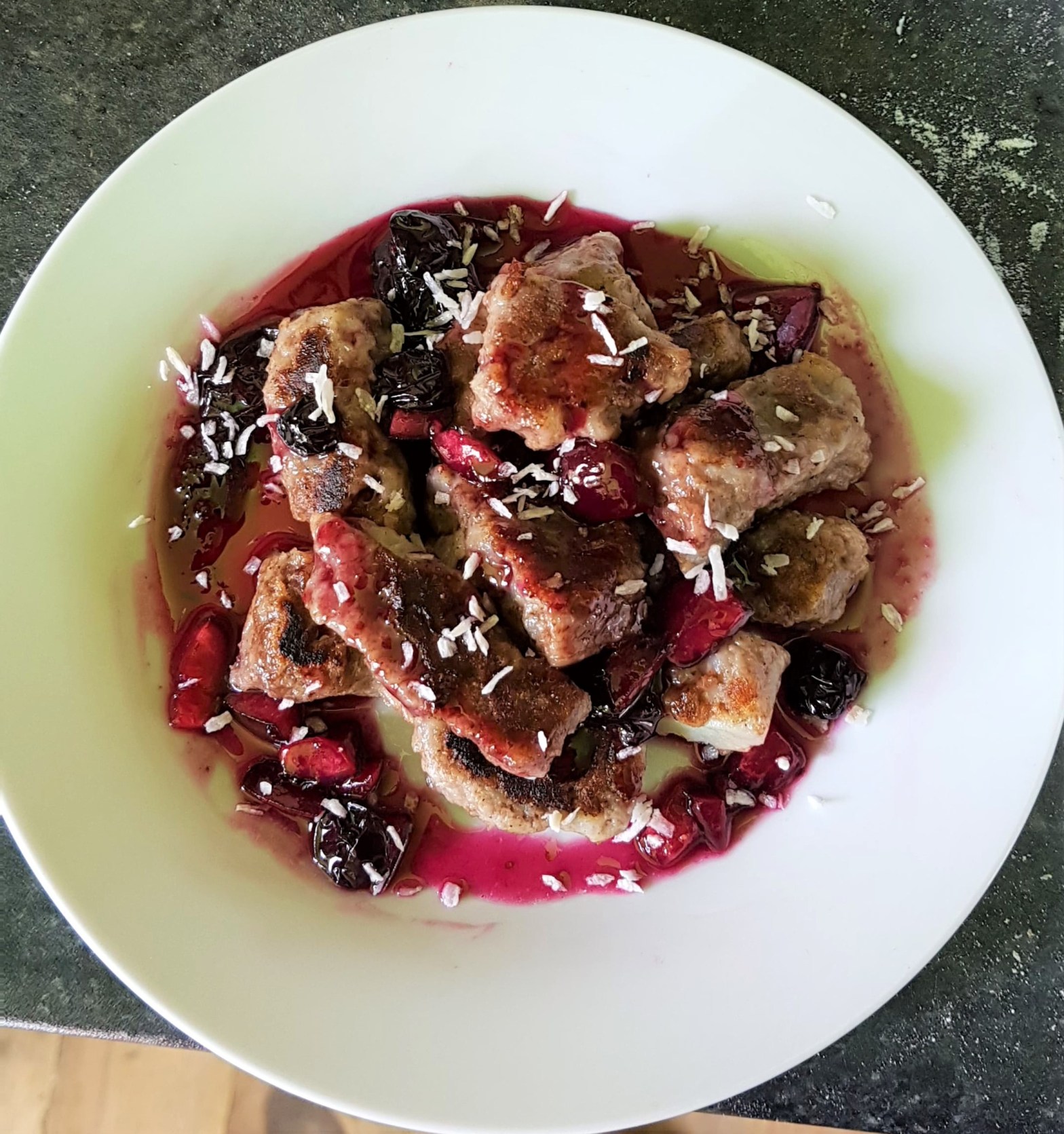
Step 8: Time to plate up! Put as many pieces of gnocchi as you want on a plate as fancy as you deserve, and drizzle with the compot. Make sure you get some of those berry pieces on there. For an extra bit of colour you can add coconut shavings to the top, or maybe some ground almond powder. Really it’s all decoration, and it doesn’t matter as long as it’s delicious.

And that’s it, the secret of the chocc gnocc, or the choccy-gnocchi, as my family calls it. It might seem like a weird thing to do, but it’s worth a try. The end result tastes something like a fried-up brownie, with hints of cinnamon that mix beautifully with the berry mixture. It is the definition of comfort food.


Now, if you’ll excuse me, I’m off to eat enough choccy gnocchi to kill a man.

If you try this recipe and enjoy it (or hate it) please let me know in the comments below!


Lets Talk About Passport Family

As a third culture kid, I wasn’t raised in the same country as the rest of my family. Even when I was growing up in America, our nearest family were a 3-hour plane ride away. My grandparents visited every summer, but everyone else was back in England, so I only had stories about them.

I grew up knowing I had a big family, with a lot of aunts and uncles and cousins on both sides; so many that as a kid I struggled just to remember their names, not knowing any faces, nevermind how we were related. I read books about growing up in a big family and thought, yeah, I can relate to this struggle. (Yeah, I was a dumb kid.)

Age 7, my parents and I moved onto a boat and began sailing around the Caribbean. Now there were no visits from my grandparents, but I had facebook, and mostly family members on it. They seemed pretty run-of-the-mill English; some public arguments in comments sections here and there, more minion memes than you could shake a franchise at, but they seemed decent.

There’s an assumption that you’re automatically close to your ‘family’. The word itself comes from the Latin word meaning “servant”. The original English meaning was close to our modern word “household” — a group of individuals living under one roof, including blood relations and servants. By that definition, I didn’t have much family.

But, I had at least three boat mothers. These were random women from the boating community without children of their own, who decided to treat me as family should treat you: they looked after me, played with me, fed me, and taught me everything and anything you’d need to know: how to haggle with the locals, how to make high-quality jewellery from nothing but a bag of beads and some fishing wire, and how to make your cat love you. (The key? I can’t tell you. Family secret.)

Some of these women have gone on to have kids since I’ve grown up, and I consider these children my nieces and nephews. I get more emails from them than I do my actual cousins.

Any other kids on boats we met became my siblings; there was no time to waste getting to know each other, because boat life is so impermanent. You don’t often spend more than two weeks in a place unless you need to renew your passport or make repairs, so there’s no time to waste being distant because you might not have anything in common with the other person.

On the same nights as I met my siblings, we’d have sleepovers, exchange Facebook and keep in touch as best we could with the crappy wifi boat life provides. Even now, my boat brothers and sisters know me better than the friends who live 5 minutes down the road. I can’t explain it; just the way it is.

Boat dads were few and far between- it seems most men choose the sailor life in order to avoid being a father and living that nuclear family life. Still, they’d tussle my hair or let me sip alcohol, just to watch me make a face and gag (‘how can adults drink that stuff? It’s so burny!’… If only I knew).

The boating community is something else, especially in the Caribbean. Most places have weekly potlucks where you all gather on the beach, bring your own big pot of food, and everybody would share with everybody else. In the morning there would be the ‘net’, where we’d all tune in our radios at the same time and listen to whatever news and gossip was floating around the community. On the radio you can even switch channels, to carry on conversations in implied privacy. If you were really nosy you could switch channels to whichever frequency the neighbours were talking on, and if you were extra cheeky you could join in with their conversation, uninvited. Nobody worth knowing minds nosiness on boats.

Fast forward to now: I’ve been living in my passport country (the UK) for almost a decade. My family is about an hour away in any direction. I know their faces now, and on a good day I can even remember how so-n-so is related to me. Usually when an unidentified number is calling me it turns out to be some aunt or another wanting to talk to my parents.

Family gatherings are nothing like a potluck- no sandy beaches in England, we congregate in pubs and chow down on greasy food someone’s pulled out of a freezer and stuck in some hot oil. Conversation is always good natured, tongue-in-cheek, and it’s a joy to listen to… until I chime in, and everything goes quiet.

I swear, I was never an awkward person on the boats. I could meet a person at noon and by dinnertime we’d be inseparable and know each other’s life stories. So how is it that my Passport Family is so perplexed by everything I say and do? Luckily they don’t linger on me long and switch back to their own banter after a minute or two of awkward chuckling where I have to try hard not to swallow my tongue in shame for ever having said anything.

As family, their knowledge about me is slender, boiling down to three things:

  1. I have a boyfriend.
  2. I go to university and study… a subject. Something artsy, probably.
  3. I’m tall.

Which really doesn’t leave a lot of wiggle room when my parents nip out for milk or and leave me alone with these people. Their collective knowledge about me leaves room for just three questions:

  1. When’s the wedding?
  2. How’s university going?
  3. You stopped growing yet? You’re about to hit the ceiling.

Since I graduated university this month, I think questions 2 and 3 are obsolete at this point. 

I don’t want to sound ungrateful for my passport, DNA-certified family. When I look back at them, we have the same eyes, same cheekbones, same sense of humour. They connect me to this passport country in a way I couldn’t be without them, that’s for sure. Still, there’s something off whenever I hear one of my friends say they can ‘just pop round’ or ‘drop in’ on an aunt or grandparent uninvited, even though I’m pretty sure my parents yeeted me through the window at some of my boat parents without much invitation on some occasions.

At family dinners, conversation revolves around my relatives and my parents, which makes sense because they’ve known each other for almost 40 years. They could probably walk the path to each other’s houses blindfolded, while I’d make a wrong turn and get run over by traffic. I’ve known these people technically my whole life, but met them a grand total of ten times, tops. We sometimes like each other’s facebook posts and indulge in family drama together, and maybe that’s the start.

As Third Culture Kids, we often talk about how out-of-place we feel within our passport country- the place we were born, but didn’t spend much developmental time. Maybe it’s time to talk about something new: the idea of the Passport Family that you are born into, which also might have you feeling out of place.


Can you relate to anything I’ve written about here? Please let me know in the comments below!


5 Songs TCKs Relate To

I’ve been listening to a lot of music from my teens (don’t ask why, I wish I knew) and realising a lot of it had a different meaning to me as a Third Culture Kid than it did to other listeners. In the process of clearing out my MP3 Player (I know, I’m old, I hate it) I found a few tunes that your inner fifteen year old TCK will bang their head to.

1. Inside the Outsider, Marina and the Diamonds

These people are really weird
And they’re giving me the fear
Just because you know my name
Doesn’t mean you know my game
I look myself in the face
And whisper I’m in the wrong place
Is there more to lose than gain
If I go on my own again, on my own again

This one is more widely relatable- who hasn’t felt like a misfit before? But it’s on a different level for TCKs. Everywhere you go is a new place with a different set of rules and customs to adjust to and learn so it looks like you know what you’re doing. Even when you return home (‘repatriate’), it’s to a country you’ve never lived in and you probably don’t know the first thing about the culture there.

Often, the way we look doesn’t ‘match’ the countries we’ve lived in (see the white TCK who grew up in Africa and repatriated to the U.S. in adulthood). No matter where you go, you’re missing somewhere. I grew up largely in Panama, but while I was there I missed Ecuador. While I was in Ecuador I missed the Caribbean, while I was in the Caribbean I missed Florida. It’s an unforgiving cycle. Sometimes your gut reaction to the constant movement is to go off on your own, rather than try to assimilate for the nth time. (Healthy, right?)

2. Leaving on a Jet Plane, John Denver

Now the time has come to leave you
One more time
Let me kiss you
Then close your eyes
And I’ll be on my way
Dream about the days to come
When I won’t have to leave alone
About the times, I won’t have to say
Kiss me and smile for me
Tell me that you’ll wait for me
Hold me like you’ll never let me go
‘Cause I’m leavin’ on a jet plane
Don’t know when I’ll be back again
Oh babe, I hate to go

This one is probably the most universal of TCK anthems. We’ve all left people in our home countries we care about, who we hope won’t forget us and who we hope will keep in touch… but when you know how big the world is, it’s impossible to stay in one place. It’s worth the risk of loosing people- you gotta keep travelling!

3. Born for This, The Score

We are the warriors, who learned to love the pain
We come from different places but have the same name
‘Cause we were born for this
We were born for this
We are the broken ones, who chose to spark a flame
Watch as our fire rages, our hearts are never tame
‘Cause we were, born for this
We were born for this

Okay, this song is a guilty pleasure. It’s too damn catchy. For me, it captures the feeling of finding a community of other TCKs– we’re all from different places, and in a way that makes us the same. We understand each others struggles on a RIDICULOUS level.

We’re also great at elevating each others skills and choosing to overlook all the struggle because in the end, we’re born to be TCKs, and that’s pretty great sometimes. We travel to different places but we find each other and pieces of ourselves everywhere we go.

4. Jet Lag, Simple Plan (Ft Natasha Bedingfield)

You say good morning
When it’s midnight
Going out of my head
Alone in this bed
I wake up to your sunset
And it’s drivin’ me mad
I miss you so bad
And my heart is so jet-lagged
Heart is so jet-lagged
So jet lagged
I miss you so bad
I wanna share your horizon
And see the same sun risin’
I miss you so bad
And turn the hour hand back to when you were holding me

Ugh, I’ve lost track of the number of times overly emotional emo me played this song and thought of people left behind in other countries. Why yes, my heart is jet-lagged. So is the rest of me. All the time. In order to avoid working out time zones, my friends and I would say things like ‘Good Mornight’ and ‘How’s your aftermorning?’ and it took so much stress off of our young brains.

The song is extra sweet for TCKs because there are four different versions. Simple Plan sings English in each version, but guest vocals are sung in French by Marie-Mai, in Chinese by Kelly Cha, alongside an Indonesian version with Kotak lead vocalist Tantri Syalindri and of course one in English by Natasha Bedingfield. We can get a special enjoyment out of each version, knowing it’s a love song pretty much written for us.

5. Good Life, OneRepublic

To my friends in New York, I say hello
My friends in L.A., they don’t know
Where I’ve been for the past few years or so
From Paris to China to Colorado
Sometimes there’s airplanes I can’t jump out
Sometimes there’s bullshit that don’t work now
We all got our stories but please tell me
What there is to complain about
When you’re happy like a fool
Let it take you over
When everything is out
You gotta take it in
Oh, this has gotta be the good life
This is probably the best part of being a TCK of any age: you have friends everywhere. Every major city in the world, there’s a couch to sleep on and someone who knows where to get the good coffee.
And yeah, we complain about planes and trains and loosing track of people, but would we actually trade it for anything? Hell no. Being a TCK is the good life. We have a unique window into everywhere, empathy off the charts, and an international community of people who understand us. Yeah, this has definitely gotta be the good life.
Design a site like this with WordPress.com
Get started