Summary
Indigenous women are extremely likely to go missing or be murdered. Statistics have been telling us this since the 1970s- although most of these are thought to be gross understatements, since many crimes against Native women go unreported or uninvestigated.
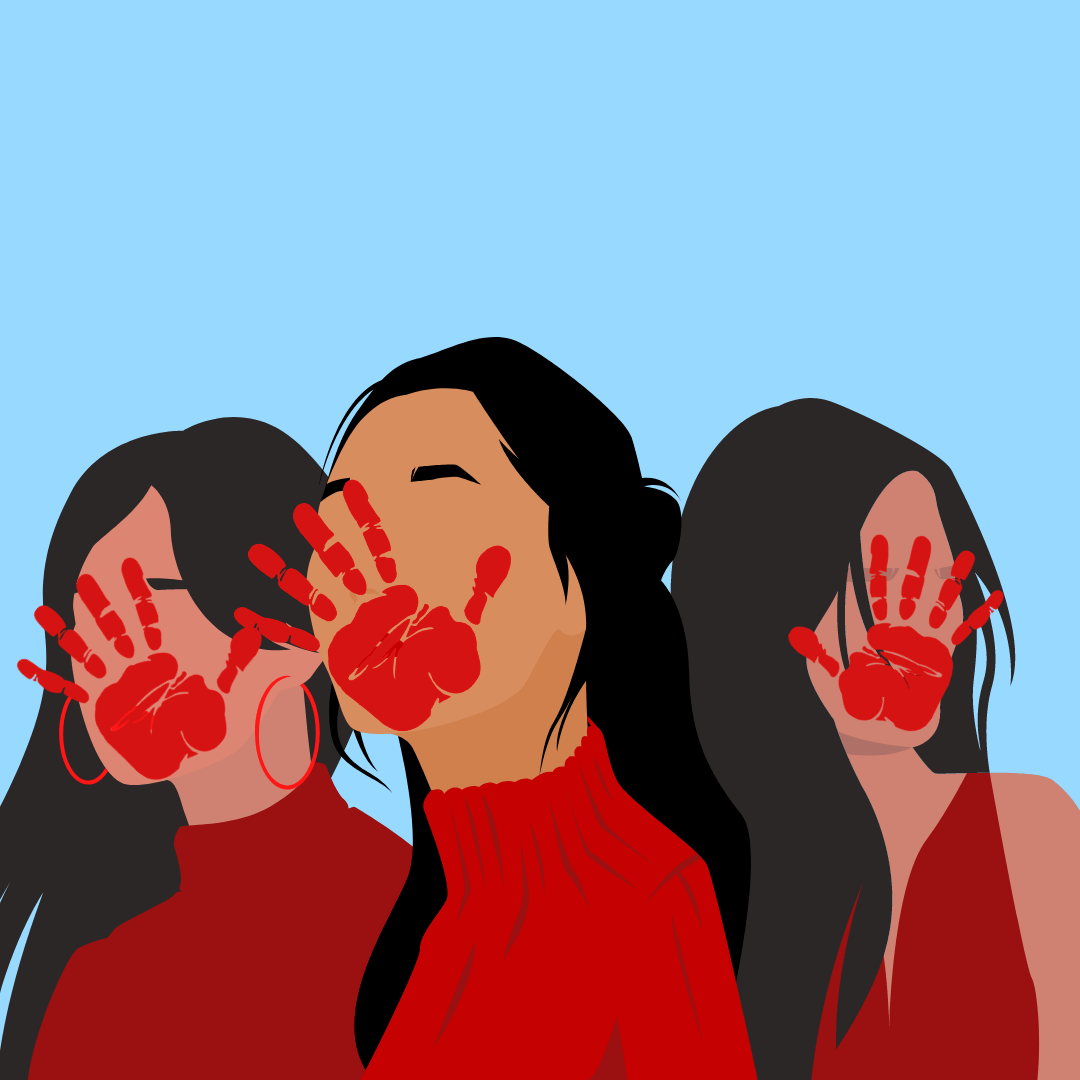
In recent years, awareness and calls for justice have been slowly growing, with many on social media and at organised events choosing to wear red handprints across their mouths, with matching red dresses, all as a way of showing solidarity and spreading awareness of the MMIW epidemic.
What is MMIW?
MMIW, standing for Missing and Murdered Indigenous Women, is a movement pushing for awareness and change for the staggering amount of Native women who have been ‘stolen’ from their families and communities by violence.
In some areas of the United states, Indigenous women are murdered at a rate 10 times higher than other ethnicities, with the majority of crimes committed on Native-owned land by non-Natives.
According to the CDC, murder is the third leading cause of death among Native women (as opposed to accidents and respiratory diseases, which tie for third place in the general population depending on how recent your statistics are). There are a lot of reasons why Native women are so over-represented in violent statistics– lack of attention from the media, legal and jurisdictional issues, lack of communication between local, tribal and state law enforcement, and more.
On social media, the movement is represented through hashtags like #mmiw, #mmiwg, #mmiwg2s, and others, such as #nomorestolensisters and #whywewearred. With a quick search, you can find videos and images of girls and women with red handprints emblazoned over their mouths, or wearing red dresses at official events.
The Red Handprint for MMIW
When talking about Native American culture, it’s important to recognise the diversity there. There are over 500 different tribes across the continent, after all. So, it should come as no surprise that there is a whole host of different meanings for the same symbols- the red handprint has different meanings across different tribes, but today its most widely-accepted meaning is all about MMIW.
Here are just a few connotations the hand print symbol on its own could have:
- Success in hand to hand combat
- Human life (with the symbol believed to channel energy to the wearer)
- Spiritual power, strength, protection, and domination
Different natural dyes could be used to paint faces, horses, and more. Red dyes and paints were made from clay containing iron oxide, berries, roots, beets, and more. It symbolised violence, strength, blood, energy, power, and success in war. When used in face paint, it could also symbolise happiness and beauty.
Red is also said to be a colour that the ancestors can see. In various ceremonies and pow-wows, some tribes dressed their children in red so that they could be introduced to (and protected by) their ancestors.
Nowadays, the red handprint is used to indicate solidarity with the MMIW movement, raising awareness for the epidemic of Missing and Murdered Indigenous Women across the United States and Canada. Often painted across the mouth, the red handprint symbolises the lack of voice given to Native women, and can be seen as a form of healing by expressing trauma.
Cultural Backlash?
Millions of posts, videos, tiktoks, you name it- are all over social media, claiming solidarity with MMIW. There’s usually some statistics, a woman’s hand over her mouth and brought away to reveal the handprint painted over her face. This has brought up some controversies among the Native community, with some saying the emblem can be used to mock or mislead people when it comes to MMIW.
The issue of Missing and Murdered Indigenous Women is so unspoken that in most conversations the only reply you get from mentioning it is a blank stare. So, spreading accurate information, taking the problem seriously, and not shying away from the enormity of the issue is vital.
Runner and activist Jordan Marie Brings Three White Horses Daniel described the increased use of the handprint as a ‘double-edged sword’- on one hand, it shows solidarity, unity, and support for the movement. On the other hand, for some Native people, the symbol can have a different meaning or context, completely separate from the MMIW movement. Others will pose for selfies in the ‘war paint’, or bring the symbolism into environments where alcohol or drugs are present, which can often come off as exploitative.
For Michelle Buckley, the red handprint represents silence and domestic abuse. In her eyes, the red handprint isn’t just for family members and survivors. She told the CBC in 2020 that, if people know why they’re using the handprint (to represent violence against girls and women), and they’re being genuine, then ‘that’s OK.’
Wearing Red Dresses for MMIW
The Red Dress Project (created by Jaime Black) started as a public art instalment in 2010. The Métis artist worked by hanging up red dresses in various locations to raise awareness for the Missing and Murdered. More than 400 dresses have been donated to the cause, with many victims’ families attending exhibitions.
According to Black, since some believe red is the only colour spirits can see, the dresses are a symbolic way to ‘call back’ the spirits of these women and girls, to allow them to be among us once again while having their voices heard through their family members and community. Within the art itself, red also symbolises violence, vitality, our lifeblood, and the ‘connection between all of us.’
There is something haunting about the red dresses hanging from trees, windows, ceiling rafters, and just about anywhere else you could think of. The sliver of red fabric billowing in the breeze has a way of reminding you that there is no longer a woman there to fill it, and yet there is a certain ‘presence in the absence,’ too. While the dresses hang there, the spirits of these women are watching, waiting for justice.
National Day of Awareness for MMIW
While October 4 was the original day to hold vigils for MMIW, May 5 has recently been made the official day to raise awareness across Canada (there’s no law against it in the US, either). On this day, vigils and marches are often organised, red dresses are displayed in home and shop windows, and you can wear a bright shade of crimson for reasons more than a love of fashion.
Running for MMIW
There are a lot of ways to be an activist, and to raise awareness for different issues. When it comes to MMIW, many Indigneous women choose to run, or play other sports, while sporting some red paint of their own in order to start conversations on and off the track.
Jordan Marie Brings Three White Horses Daniel
In April 2019, Daniel dedicated each mile of the Boston Marathon to a murdered Indigenous woman or girl. She ran the whole thing with a red handprint over her mouth, and MMIW written on her legs.
A citizen of the Kul Wicasa Oyate tribe from South Dakota, Daniel works at UCLA as an outreach and project manager, as well as being a documentary film producer, and even a sponsored runner for Lululemon’s global ambassador program. When asked why she used the red paint on her run, she said that she ‘wanted to do something’ with her run, to ‘give back to our stolen relatives and to their families.’
Rosalie Fish
In June 2018, Fish honoured several Indigenous women at her state track and field meet:
- Misty Anne Upham (in her 400-metre final)
- Alice Looney (in the 1,600m)
- Jacquline Salyers (in the 800m)
- Renee Davis and her unborn child (in the 3,200m)
All women were victims of violence, and were depicted on a poster Fish brought with her to the meet. It was the first time Fish (a member of the Cowlitz tribe in Washington) had ran for anyone other than herself, and ‘the first time I’ve ever made a scene and not been apologetic.’
She went on to say, ‘Nobody is going to listen to me. As a teenage girl, nobody has to care what I say. But when I run about it, people will notice.’
The Ignacio High School Girls Basketball Team
In December 2019, every member of the Ignacio High School girls basketball team donned a red or black handprint and participated in a photoshoot to honour Missing and Murdered Indigenous women. 80% of players on the team come from the Southern Ute tribe.
Fans were encouraged to wear red to their game, and as part of the pre-game festivities there was an opening prayer, drum circle, and speech by Christine Sage, Southern Ute Tribal Chairwoman.
Final Thoughts
While the pandemic has us all inside, many unable to go to marches or protests for fear of infection, wearing a red dress, handprint, or other symbol of the movement can be considered one of few ways to show our solidarity with MMIW from behind a screen. There are more practical things you can do, too:
- If you’re in the United States of Canada, you can write to your local representative and demand they address MMIW.
- Share articles, information, posts, etc.
- Have conversations with friends and family members- make sure that after 10 minutes with you, they know what MMIW is.
- Donate to different MMIW charities.
 Culturally Confused