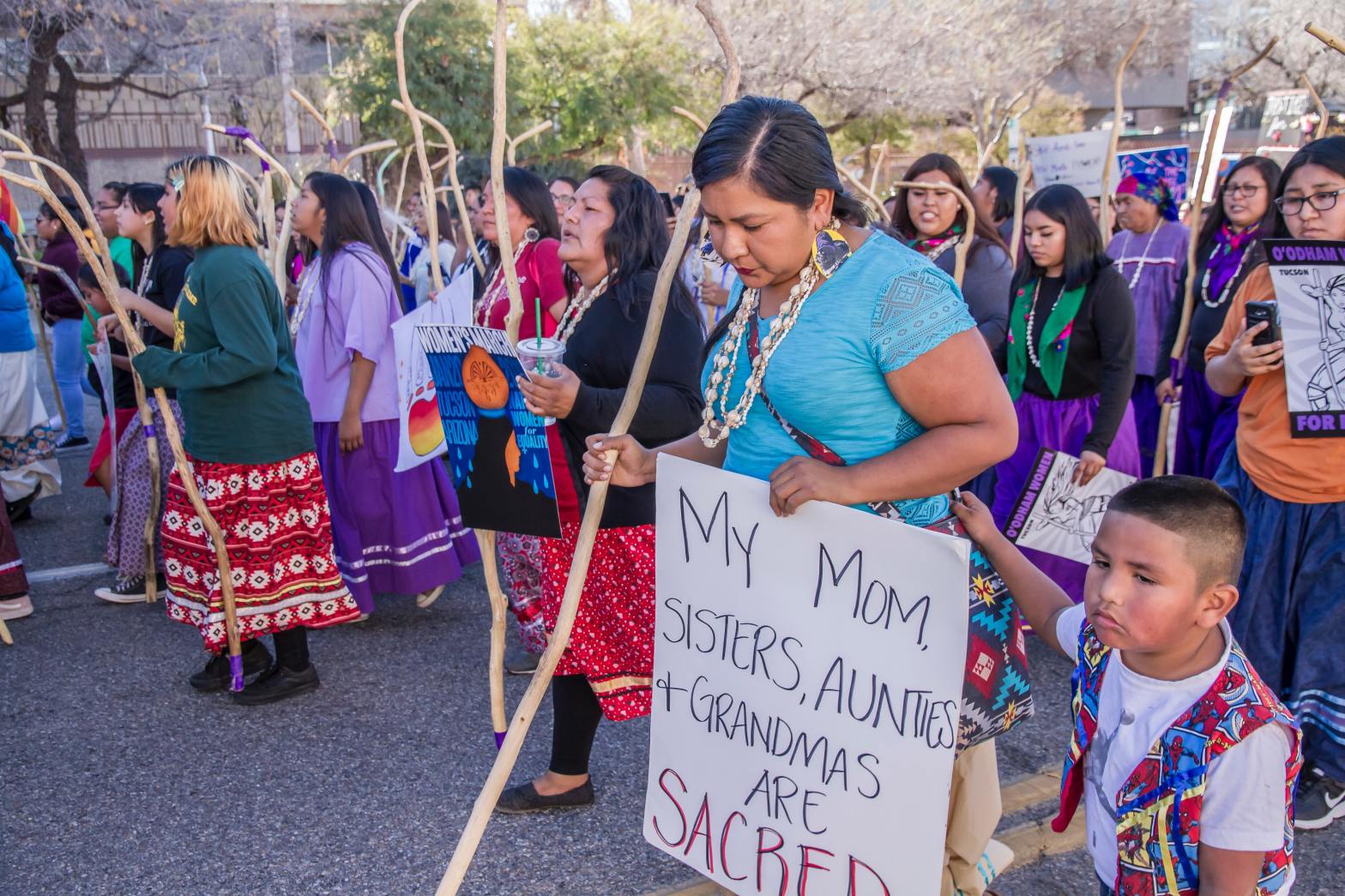
All across the North American continent, Indigenous women, girls, and two-spirits are going missing or being murdered at crazy rates- in some places, they are victimised more than any other ethnic group. In this article, we’ll be discussing in detail just how many Missing and Murdered Indigenous Women (MMIW) there are in the US and Canada, as well as a few reasons this might be, including:
- The Media
- Jurisdictional Issues
- ‘Man camps’
- Lack of resources
And more. The issue is as complicated as it is important, so buckle up.
What does MMIW mean?
First things first: what is MMIW awareness? What does it mean? It feels like every day we wake up to another acronym to be aware of, but this one is so sinister it is instantly easy to remember: Missing and Murdered Indigenous Women. The movement is also known by the alternate hashtags you’ll probably see popping up now and again on social media: #mmiwg (g standing for girls) and #mmiwg2s (2s standing for two-spirits).
The plight of Native women and girls has been called a genocide by the Canadian government and an epidemic by even former president Trump’s government. With an official ‘MMIW day’ set as May 5th (as of 2017), the issue is increasingly prevalent in most Indigenous communities, however it is yet to enter worldwide discussions in the same way as Black Lives Matter. There are a few reasons for this, such as lack of media attention and the physical isolation of many Indigenous communities.
How Many MMIW are there?
How Many MMIW are There in Canada?
According to one 2020 article by the Guardian, Canadian Indigenous women and girls are twelve times more likely to be murdered or go missing than any other group. In June 2019, president Justin Trudeau’s government named the crisis a genocide, reeling from the final report delivered by a national enquiry that was years in the making.
An action plan was due in June 2020, but (thanks to the COVID-19 pandemic) it was postponed- and that’s pretty much the last we’ve heard about it since, despite these shocking MMIW stats for Canada:
- Over 4,000 Native women and girls have gone missing in the last 30 years. That’s 133 a year- three a week.
- Most MMIW cases are murders, not missing persons.
- According to the NWAC, between 2000 and 2008, Native women and girls made up 10% of all female homicides in Canada, despite being just 3% of the population.
- Only 2% of the cases in the NWAC’s database occurred before 1970, suggesting there are many older cases that have gone undocumented.
- Only 8% of MMIW cases involve women over 45, and 17% involve girls under 18 years old.
- Almost half of murder cases in the NWAC database remain unsolved.
- Only 53% of murder cases lead to actual murder charges, as opposed to the 84% overall homicide clearance rate for Canada.
Finally, a more recent number: Native Women make up 4% of Canada’s female population, but made up 16% of female murder victims from 1980-2012, according to a 2014 report by the Royal Canadian Mounted Police (RCMP).
Even after the national enquiry into MMIW began, and the government start taking an active interest in the issue, there was no sense of deterrence reflected in the statistics. One 2019 CBC article reported that there have been three deaths of Native women and girls every month from 2016-2019. Most of these deaths were one of three types:
- Homicide
- Unknown causes (but suspicious circumstances)
- Death while in institutional care or custody
How Many MMIW are There in the US?
As of 2019, multiple Western states (as well as Congress) have started creating legislation and enacting executive orders centred around the MMIW epidemic. Though no studies comparable to those in Canada have taken place yet, meaning there is simply no way to know for sure the true MMIW stats in the United States, but here’s what we know from what has been conducted:
- 84% of Native American women have experienced violence in their lifetime, according to a 2016 study by the Department of Justice.
- On some reservations, Indigenous women are murdered at 10x the national average.
- 96% of the violence is perpetrated by non-Native men.
- 67% of cases involving Native-related sexual violence were declined prosecution by US attorneys.
- On some reservations, 96% of women experience sexual violence.
One study by the Urban Indian Health Institute (UIHI) compared information gathered across the country to information from law enforcement agencies and comparable groups. The numbers indicated there were 5,712 missing or murdered Indigenous women across the United States in 2016 alone. However, only 116 of these cases were recorded in the US Department of Justice’s ‘official’ missing persons’ lists.
Current numbers from the UIHI and National Crime Centers show over 5,000 Native women go/have gone missing every year since 2016, but some numbers put this much, much higher.
In November 2020, then-president Trump signed an executive order to create an MMIW task force.
It’s also worth mentioning that MMIW stats across the US and Canada are likely to be much higher than we think, since Indigenous women are often mistaken for Latina, Caucasian, or Asian women; and are therefore racially misclassified when they are found, or when ‘official’ missing persons information comes out.
Why is MMIW Happening?
If you want a famous example of a MMIW, look at Pocahontas, a native child who was sex trafficked and taken to England, where she was likely pressured into marriage with one of her captors. She wasn’t the first, and she’s far from the last. I mention her here just to give you an idea as to how long these ideas have been festering, mostly unchallenged, throughout history.
It’s important to realise that MMIW isn’t because of any one issue- there are many, many things you have to look at and understand before we can talk about possible solutions. That being said, here are a few possible causes of MMIW:
- Native women have been fetishised and exoticised by colonial authorities– if the patriarchy/male gaze has dehumanised women as a whole, it has dehumanised women of colour (including Native women) tenfold.
- The Media- 95% of cases involving murdered or missing First Nations women were ignored by international or national news media, according to one 2018 study by the UIHI.
- Jurisdictional Issues– the majority of crimes against Native women are committed by non-Native people, which is a bigger problem than you might think. Tribal authorities have little jurisdiction over sexual crimes or murders committed by non-Natives, even if the crime happens on Native territory. Essentially, non-Natives (particularly speaking, white men) are not held to account for their sexual or other violent actions towards Indigenous women and girls; by law, they can’t be punished or properly investigated by tribal authorities.
The federal government is supposed to pick up the slack here: they are tasked with investigating these violent crimes and punishing the culprits, but, as we stated earlier, they decline to prosecute almost 70% of cases.
- ‘Man camps’ – By now, you’ve heard about pipelines and protests about Native land. What you probably don’t know, however, is the problem posed by the workers who make pipelines. Work-camp modular housing, also called ‘man camps’, are temporary housing communities made for the mostly male workers, and are often located close to Tribal lands or other marginalised communities. Despite numerous reports, studies, and congressional hearings connecting these camps with higher rates of sex trafficking and violence, little is being done to help police the issue.
Worse: many rural communities don’t have that many police officers to begin with, and they can be left policing a sudden influx of hundreds of outsiders- and, if a non-Native commits a crime on Tribal lands, they often can’t be investigated by law.
- Inadequate Police Response– Canada’s national enquiry into MMIW found a lot of problems around police responses to Native issues. Whether it’s individual or institutional racism, or a combination of the two, the result is the same: police failure. Lack of trust in law enforcement. Both issues span generations, and if no reparations or recognitions are done, the problem will continue.
- Lack of Resources– there have been calls for Indigenous communities to have proper funding for their own police services, as well as proper jurisdiction. While these services already exist, look no further than the First Nations Policing Program in Canada, which has been described as ‘chronically underfunded’, leading to burned-out officers, more lack of trust in law enforcement, and as a result, an inability to properly investigate violence and sexual crimes in First Nations communities.
- Human Trafficking- 2016 statistics from the RCMP showed that, while Native women were 4% of the Canadian population, they were 50% of human trafficking victims. Of those, almost 25% were younger than 18 years old. Murder is not an uncommon result of human trafficking, either. Common places recruiters will pick up women and girls can be: bus stations, airports, schools, hitchhiking, and essentially anywhere a woman might be alone or far from home.
Final Thoughts
There may well be light at the end of the tunnel for MMIW, but for now the issue is ongoing. With the Canadian government postponing any recommendations post-enquiry, and scepticism around Trump’s MMIW taskforce having adequate funding, change is a long way off. And we don’t have that long- people are dying. While the Canadian report made hundreds of suggestions, here are just a few things that could help stop MMIW:
- Proper awareness
- A national database for missing Native women
- Proper jurisdiction given to Tribal authorities and governments
- Support and resources for First Nations communities
This issue permeates all levels of society, and all nations have some kind of reckoning to be had with colonialism; not just North America. It’s not the job of any one agency or person to ‘fix’ the problems around colonialism or MMIW, but the least you can do is have a conversation, take action to raise awareness, and go from there.
 Culturally Confused
One thought on “Simply Complicated: How Many MMIW are There?”